
【PCI DSS Compliance for Dummies】
Even cybersecurity beginners can achieve compliance — the top 6 questions asked (3W3H) when first required by an acquirer or supervisor to obtain PCI DSS certification.
As the booming growth of e-commerce, remote work, and delivery platforms continues, the usage of cross-border transactions and online payments has accelerated, making payment card information security increasingly critical. To protect cardholder personal information, the Payment Card Industry Security Standards Council (PCI SSC) mandates that all entities storing, processing, or transmitting cardholder data must comply with PCI DSS requirements.
What is PCI DSS?
PCI DSS stands for Payment Card Industry Data Security Standards, established and managed by the international organization Payment Card Industry Security Standard Council (PCI SSC). These standards are specially designed to protect payment card data from unauthorized access and misuse. PCI SSC comprises major global credit card organizations, including American Express, Discover Financial Services, JCB, MasterCard, Visa Inc., and China UnionPay.
PCI DSS standards are a set of industry-wide guidelines focused on securing cardholder information across these brands. They apply to all entities which store, process, or transmit cardholder data — merchants or service providers handling payment cards from these brands, regardless of their size or transaction volume.
Who needs PCI DSS Certification?
Any organization that stores, processes, or transmits cardholder data is required to comply with PCI DSS standards. Step 1: determine whether the entity is a Merchant or Service Provider.
Merchants
Organizations that accept payment cards in exchange for goods or services — physical stores, online stores, and those offering downloadable virtual goods or services.
Service Providers
Entities that transmit, process, or store payment cardholder data as part of services they offer, or that can control or influence the security of cardholder data — including third-party payment processors, payment gateway providers, wallet service providers, and online marketplaces. Data centers and cloud service providers offering virtual hosting services also belong to this category.
Step 2: identify the PCI DSS level. Level 1 merchants and service providers require an on-site assessment by a Qualified Security Assessor (QSA). Level 2–4 merchants and Level 2 service providers can use the PCI DSS Self-Assessment Questionnaire (SAQ) for self-assessment, or seek assistance from a QSA for a faster and more accurate evaluation.
Who can assist PCI DSS Certification?
QSA (Qualified Security Assessor)
A professional authorized by PCI SSC, trained and certified to conduct PCI DSS assessments and provide Reports on Compliance (ROC) and Attestations of Compliance (AOC). QSAs must regularly update their certification to stay current with the latest PCI DSS versions. If your organization is a Level 1 merchant or service provider, an on-site assessment by a QSA is mandatory.
QSAC (Qualified Security Assessor Company)
Employs QSAs and provides expert assessment and consulting services. A QSAC can assist you in understanding the specific requirements of PCI DSS and guide you in establishing a secure payment environment.
How to choose a QSA and QSAC?
- Visit the PCI Security Standards Council website to verify certified QSAs and QSACs
- Inquire with peers or partners who have completed PCI DSS assessment about their experience and recommendations
- Review customer evaluations and case studies of potential QSAs and QSACs to ensure their experience and expertise
- Conduct initial consultations with multiple QSAs or QSACs to understand their service scope, fees, and work process
How to do?
PCI DSS Compliance Assessment normally consists of 4 main stages:
1. Preparation Stage
Scope confirmation and consulting phase — preliminary assessment of existing security measures to identify gaps, defining the assessment scope (systems, networks, and applications), engaging a consultant or QSA, and providing employees with security training.
2. Data Preparation Phase
Preparation and implementation of necessary controls — develop and update security policies and operational procedures, and gather and organize all required documents and evidence to demonstrate compliance.
3. Assessment Phase
QSA conducts the on-site assessment — internal reviews before formal assessment to ensure all issues are addressed, then the on-site assessment led by the QSA to verify consistency between actual operations and documented practices.
4. Report Phase
The QSA writes the Report on Compliance (ROC) and Attestation of Compliance (AOC); you submit the report to the payment card organization or acquirer, and receive compliance certification from the QSAC.
How long does it take?
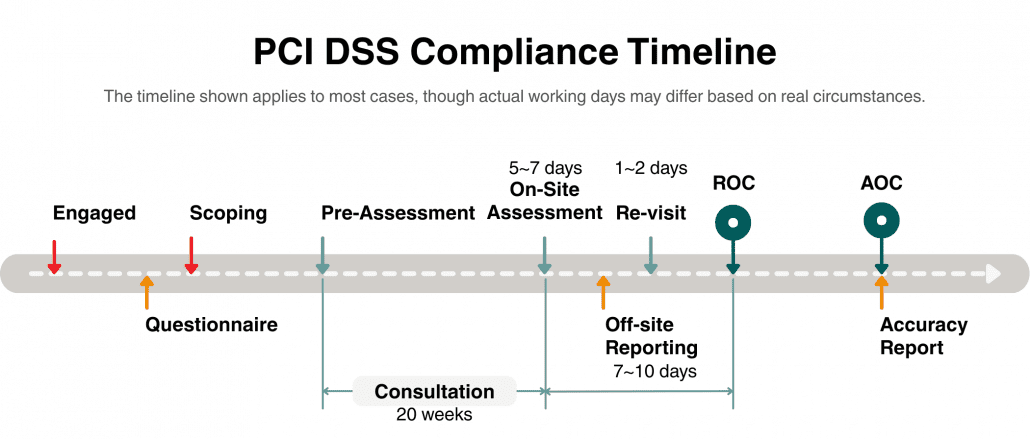
The overall timeline for achieving PCI DSS compliance certification, from initial environment verification to providing final reports, is about 3 to 5 months:
- Preparation Stage (1–2 months): environment verification and consultation phase
- Data Preparation Stage (1 month): preparation and implementation of necessary control measures
- Assessment Stage (5–7 days): on-site assessment conducted by QSA
- Report Stage (0.5–1 month): QSA writes and submits compliance reports and certifications
Actual timelines may vary due to preparedness, complexity of systems and operations, and the resources invested (manpower, time, and budget). To ensure an efficient process: begin preparation as early as possible, maintain close communication with your QSA, and continue maintaining and improving security measures after certification for long-term compliance.
How much does it cost?
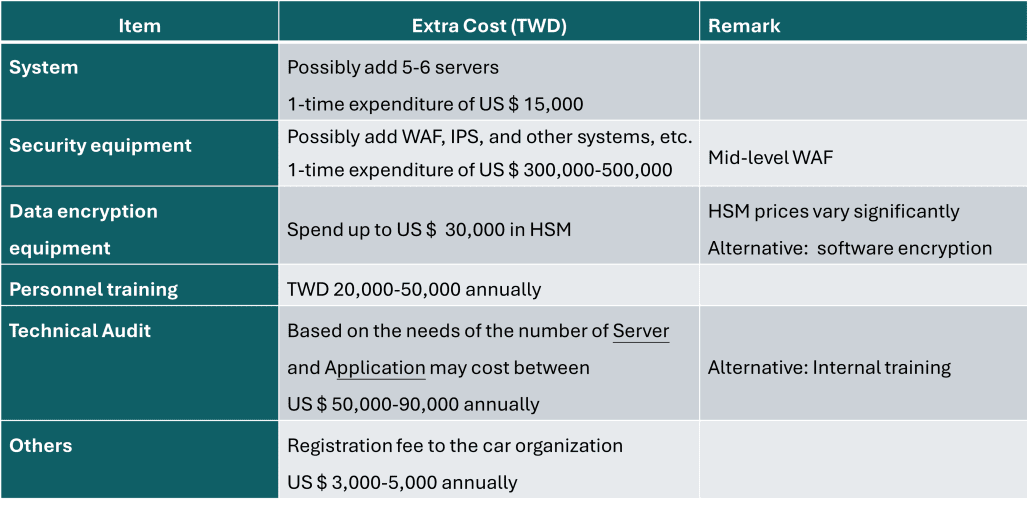
Estimated additional costs for first-time PCI DSS compliance:
A. System
Due to the high-security requirements of PCI DSS, certain systems may need to be separated to comply with requirements such as having only one primary function per system component (Req. 2.2.3). Functions like Web Server, Application Server, and DB Server previously on one machine may need to be split, potentially requiring additional server equipment (virtual servers can be used). Security components like NTP Servers, FIM Servers (File Integrity Management), and Log Servers may also be needed.
B. Security Equipment
Meeting PCI DSS security requirements may necessitate purchasing additional security equipment such as Network Security Control devices (NSCs) like firewalls, Intrusion Prevention Systems (IPS), Intrusion Detection Systems (IDS), and Web Application Firewalls (WAF).
C. Data Encryption Equipment
Depending on your environment, data encryption equipment and related controls may be required to protect stored cardholder data. Contact our consultants for a detailed estimate for your environment.
Ready to start your PCI DSS journey?
Talk to our QSAs for a scope confirmation and quotation.
Contact Us